
LUX-ZEPLIN (LZ) is a flagship physics experiment searching for the elusive dark matter particles which many scientists believe make up most of the mass of the universe.
The LZ detector employs a 7-tonne liquid xenon target to search for the rare interactions of these particles with ordinary atoms in the detector medium. The experiment is located one mile underground at the Sanford Underground Research Facility (Lead, South Dakota, USA).
This is the website for LZUK, the collaboration of ten UK institutes working on LZ. The website for the international project can be found here.
Latest News
SEPTEMBER 2026

LZ presents major results from a search for high-energy nuclear recoils at TeV Particle Astrophysics conference in Tendo, Japan, on 1st September 2026. Presentation by Sam Eriksen (University of Bristol). Draft publication on LZ website from 15:00 BST.
DECEMBER 2025
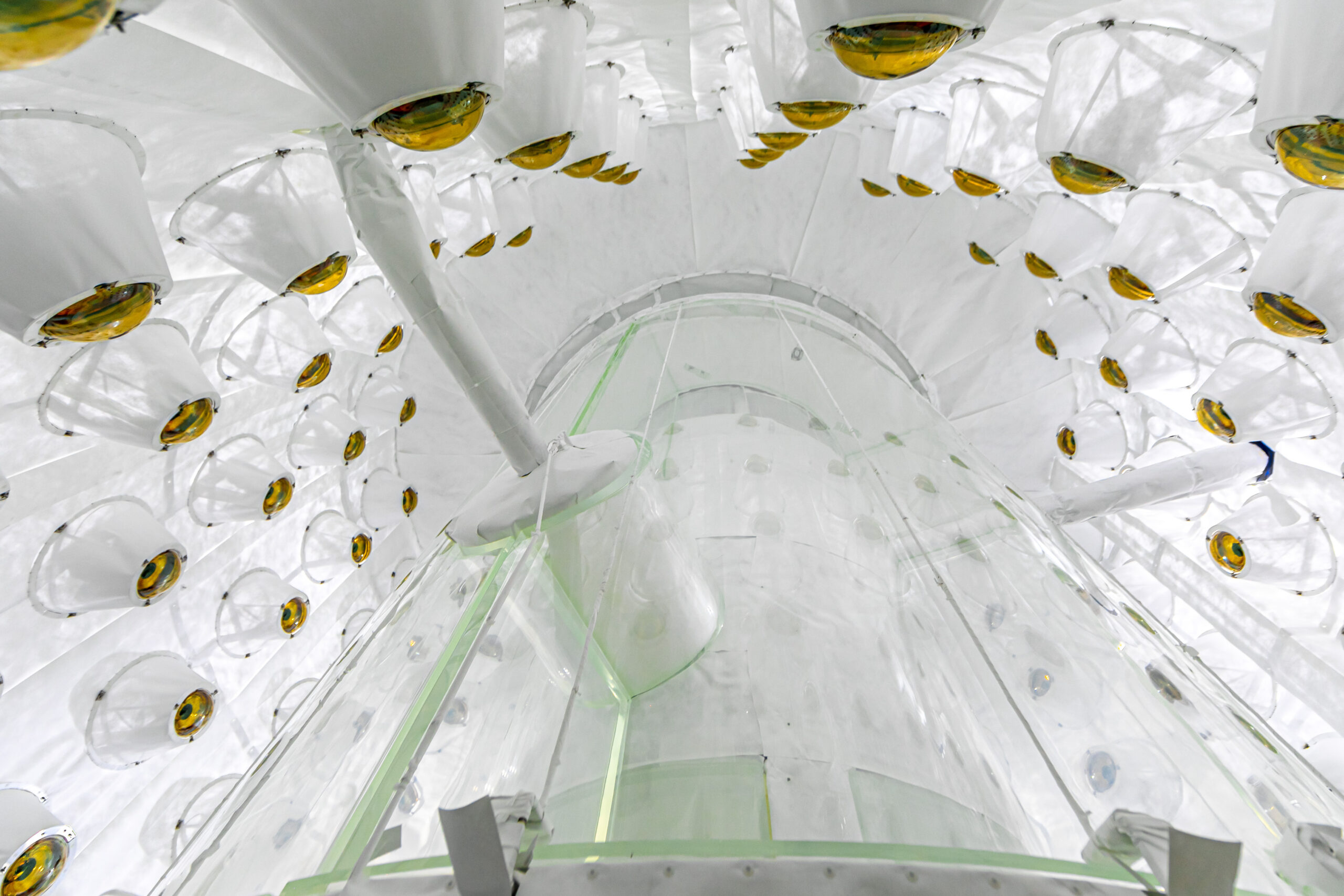
LZ Announces First Significant Detection of Solar Boron-8 Neutrinos via Coherent Elastic Neutrino-Nucleus Scattering (CEnVS)
AUGUST 2024

LZ Announces Newest World-Leading Dark Matter Result
JULY 2022

LZ Announces Successful Start of Operations and First Science Results
JULY 2021

Liquid Xenon Collaborations Join Forces
OCTOBER 2020

CD-4 Approval – LZ Concludes Construction Phase
OCTOBER 2019

LZ Detector Moves Underground (Carefully…)
JULY 2018

UK Delivers Titanium Cryostat to Sanford Lab
JANUARY 2017

CD-3 Approval — Next-Generation Dark Matter Detector in a Race to Finish Line
SEPTEMBER 2016

Construction of World’s Most Sensitive Dark Matter Detector Moves Forward
MARCH 2015

CD-1 Approval and Project Kickoff in the UK — LZ Becomes a Project
Latest Publications
LATEST DARK MATTER SEARCH RESULTS
New results from the extended science run of LZ, combining 2022 and 2024 data, reaffirm the detector’s excellent performance and setting much stronger world-leading limits on WIMP interactions
FIRST RESULTS FROM LZ
Results from the first science run of LZ, confirming the technical performance and world-leading search results from a short “engineering run” in 2022.
SENSITIVITY TO WIMP DARK MATTER
A detailed simulation study of the expected sensitivity of LZ to WIMP dark matter interactions, published before commissioning the experiment.
INSTRUMENT PAPER
The description of the LZ experiment as built: major subsystems of the experiment and its key design features and requirements.
TECHNICAL DESIGN REPORT
The design and performance of the LUX-ZEPLIN (LZ) detector are described as of March 2017 in this Technical Design Report.
CONCEPTUAL DESIGN REPORT
The design and performance of the LUX-ZEPLIN (LZ) detector are described as of March 2015 in this Conceptual Design Report.
LUX PUBLICATIONS
The LUX experiment was decommissioned in 2016 to make way for LZ, but its data continued to produce important scientific and technical results.
LZUK Organisation
PARTICIPATING INSTITUTES

About the participating institutes.
ORGANISATIONAL ROLES

Find out how LZUK is organised.
CONTACTS

Find contact details.